You can find the complete first draft of The Dead Isle here.
Showing posts with label fantasy. Show all posts
Showing posts with label fantasy. Show all posts
Saturday, September 18, 2010
The Dead Isle
You know I love Sam Starbuck, and find his unusual process fascinating. I read Nameless and Charitable Getting and all that's available of Valet of Anize, but I can't believe I hadn't finished reading The Dead Isle until now. Its' first draft has been sitting in my Firefox tabs for months, which is absolutely not to say that it deserved to be put off. It is a story of adventure, fantasy, alternate history, steampunk, and revolution, and it is fabulous. It made me want to learn about all sorts of things, which is a reaction that I associate with all my favourite books. And how often to you get to read the whole first draft of a novel? The final, paper version is not yet available, but some day it will be, and I'm sure it will be a fascinating exercise to compare the two. And though I know major revisions are planned, this story is already wonderful. I'm sure rewriting will make it even better, but don't be afraid to read it as it is. I won't review it properly, because it somehow doesn't seem fair to review a first draft, though I wouldn't really have any serious criticism to make.


Monday, August 2, 2010
Review: Interworld
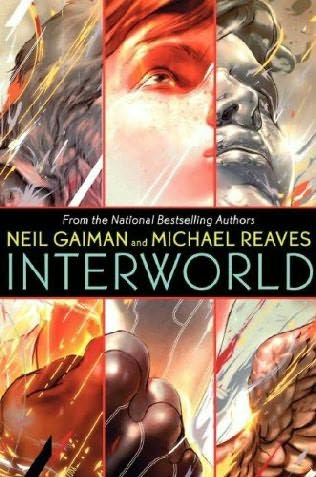 I've always loved fantasy novels, but my favourites are never the kind with dragons and castles. I like the slightly weird fantasy, the kind with interesting concepts and a little bit of sci fi, too. Interworld, by Neil Gaiman and Michael Reaves, is definitely this sort of fantasy.
Joey Harker is an ordinary sixteen year old boy with absolutely no sense of direction. When his tenth grade social studies teacher assigns a test that requires him to find his way to a certain place in town, he doesn't think he has much chance of passing the class--especially not when he walks through a cloud of fog into a world where the McDonald's sign is plaid and his mother doesn't know who he is. Joey soon finds that his Earth is part of the Altiverse, a collection of parallel Earths separated by the In-Between, a strange realm that owes a lot to M.C. Escher, Picasso, and a lava lamp. The Altiverse must be held in balance between those Earths governed by magic, and those governed by science, and it is up to all the Joey Harkers from all the Earths to do this.
I love stories that make use of parallel world theories, and this one is especially clever, with the idea of all the parallel versions of the same person having the power to Walk between worlds. I expect nothing less of Neil Gaiman than thoroughly imaginative storytelling and wonderfully bizarre visuals, and he has certainly delivered on this. It's a great book, meant for young adults but quite universally enjoyable.
Monday, June 7, 2010
The Princess Bride
 The film version of The Princess Bride feels like a huge cultural institution to me, despite the fact that I've only seen it about one and a half times. Everybody knows, "Hello, my name is Inigo Montoya. You killed my father. Prepare to die." Somehow the book is a bit less of an institution. Possibly this is because, at least for me, the movie is more satisfying.
The book operates on an oddly contrived pretense, that William Goldman is abridging a much longer work by a fellow named Simon Morgenstern, who comes from the country of Florin, in which the book is set, which of course does not exist. This has me thinking back to all my experimental theatre last fall, when I spent a lot of time considering the layers involved in stories. The movie, of course, opens with a sick kid in bed whose grandfather reads him the story, and once in a while they show up again when the kid objects to some part of the story. In the book, this sick kid in bed is in the past, being William Goldman, first introduced to the story in this way, and coming back years later to do the abridgment. His asides are often about the dull parts of the novel he has supposedly cut out, and he's created an entire story about his wife Helen and his son Jason, and trying to get Jason to read the book, and about legal troubles with S. Morgenstern's estate. It's an unusual storytelling device, and somewhat distracting, but it's often entertaining. It also allows Goldman to blame plot difficulties and unpleasant moments on S. Morgenstern. The ending of the book is a little sudden, and not very conclusive, and Goldman blames that on Morgenstern.
I've had the book for years, for unknown reasons, and I sort of wish I'd read it sooner. I did try, I just thought Buttercup was the stupidest name for a heroine ever, and couldn't get past that. I had very strong opinions about names and words in my younger days, I guess. I sort of still do; Buttercup just stopped bothering me. Anyway, it's a book thoroughly worth reading, since it is a "classic tale of true love and high adventure", and everyone can use more of that in their life.
Wednesday, June 2, 2010
The Physick Book of Deliverance Dane
 Sometimes, you read the right book at the right time. I got The Physick Book of Deliverance Dane, by Katherine Howe, for Christmas, but it's been sitting on the shelf over my desk since, unread. When I finished reading The Doctor Trap I wanted to pick up something new right away, and though I'm still in the middle of Victorian Visitors, I wanted fiction. The Physick Book was the natural choice.
It tells the story of Connie, a Harvard graduate student in history, who goes to stay in her grandmother's ancient house in Marblehead, Massachusetts to clean it out in preparation for selling it. The house has no electricity and no telephone, and it's been empty for twenty years. Connie is meanwhile supposed to be figuring out a dissertation topic for her PhD. Her first night in the house, she opens a 17th century Bible and out falls an old key, with a bit of paper in it that bears the name Deliverance Dane. Deliverance proves to be one of the women accused in the Salem with trials of 1692, and the story unfolds from there.
I loved this book for much the same reasons I love Tam Lin--its elements of the academic world and hints (or more than hints) of fantasy and romance. The Physick Book of Deliverance Dane has so many wonderful strands of plot, clever foreshadowing, and characters who are not quite who they seem, which are finally drawn together in a clear and interesting way. This is not literary fiction, and in fact has many qualities of a thriller, but it is well-written and well-told, and it's a very good story. Thoroughly satisfying, so much so that I read most of it in great chunks over the holiday weekend. It's a good holiday book, is what it is, and it helped remind me how much I love sitting and reading for hours on end.
Sunday, August 30, 2009
Tam Lin
I've never done a proper post about Tam Lin, though I mention it all the time. I even promised one in my very first post here, the last time I reread it.
I've read every novel Pamela Dean has written, and am terribly excited about the new one she's writing, especially since she hasn't published one since 1998. Tam Lin is my favourite, though I have a certain fondness for The Secret Country trilogy.
You may or may not know the story of the ballad of Tam Lin--I didn't the first time I read the book, and I think my enjoyment of it benefited from this. I was so wrapped up in the story I didn't even realize who Tam Lin was. Though I was completely surprised by the story's outcome on my first reading, knowing the ending has done no harm to my rereadings.
Janet Carter, our heroine and the character through whom, despite the third person telling, we view the story, is a freshman at Blackstock College in 1971. She's an English major, and her father is an English professor at Blackstock, so she's been reading Shakespeare and Keats since she was small. She has two roommates, Molly and Tina, and sundry Classics major friends, notably Nick, Thomas, and Robin. The book plows through her freshman year, meals in various dining halls with unfortunate food, trips to see Hamlet and Rosencrantz and Guildenstern Are Dead, walks around campus, and a good dose of suspicious, slightly supernatural events, then moves on to tell the rest of her time at Blackstock, ending fall of her senior year. There is much talk of college life, classes fascinating and dull alike, studying, love affairs, friendships and their problems. It is this couching of relative ordinariness that shows the extraordinary parts of the story so well, and that distracts us from putting together all the clues. We learn in the first few pages that Classics majors are a little weird--it's a campus joke even Janet's little brother finds funny. We soon learn that the whole Classics department is suspicious, and then of course Janet has to deal with the ghost that throws books out the window of her dorm room. And whether or not you know the story of Tam Lin and can predict how it will turn out for Janet, there are still mysteries left to solve.
Why do I love this book so very much? First of all, Pamela Dean is a lovely writer--dryly humorous, and so very good at the urban fantasy genre, giving us the bits of normal life as well as the fantasy, so that it all seems so much more believable. Secondly, the book is absolutely full of literary references; they're all quoting constantly and making parallels with bits of literature. On the one hand this is idealistically pleasing, since wouldn't it be lovely to be able to quote Shakespeare all the time and have people who could quote him back to you? I always thought it would, or maybe I just discovered Pamela Dean's novels and realized I would have loved to grow up reading Shakespeare. On the other hand, it's easy to make these references a game, seeing which ones you catch and then rereading the book again later and catching more of them, some maybe you hadn't first realized were references at all. And as I mentioned yesterday, Tam Lin always inspires me to more reading, which can't be anything but good. Third, for ages this has been my college book. I read it for a view of college and always envy Janet all she gets to learn. Blackstock is heavily based on Carleton College (minus the suspicious Classics department and the ghosts, of course), and this is pretty much the main reason I applied to Carleton. I didn't get in, but still Tam Lin had a definite effect on where I applied to college and perhaps also how I made my decision. It's a bit fitting that I read it a month before I start college, but it's just made me impatient. I want to start learning things now.
Tam Lin is both a comfort read and a book that inspires me to read a little outside my comfort-zone, and though perhaps it's not the best book ever written, I can pretty confidently call it my favourite.
I've read every novel Pamela Dean has written, and am terribly excited about the new one she's writing, especially since she hasn't published one since 1998. Tam Lin is my favourite, though I have a
 certain fondness for The Secret Country trilogy.
You may or may not know the story of the ballad of Tam Lin--I didn't the first time I read the book, and I think my enjoyment of it benefited from this. I was so wrapped up in the story I didn't even realize who Tam Lin was. Though I was completely surprised by the story's outcome on my first reading, knowing the ending has done no harm to my rereadings.
Janet Carter, our heroine and the character through whom, despite the third person telling, we view the story, is a freshman at Blackstock College in 1971. She's an English major, and her father is an English professor at Blackstock, so she's been reading Shakespeare and Keats since she was small. She has two roommates, Molly and Tina, and sundry Classics major friends, notably Nick, Thomas, and Robin. The book plows through her freshman year, meals in various dining halls with unfortunate food, trips to see Hamlet and Rosencrantz and Guildenstern Are Dead, walks around campus, and a good dose of suspicious, slightly supernatural events, then moves on to tell the rest of her time at Blackstock, ending fall of her senior year. There is much talk of college life, classes fascinating and dull alike, studying, love affairs, friendships and their problems. It is this couching of relative ordinariness that shows the extraordinary parts of the story so well, and that distracts us from putting together all the clues. We learn in the first few pages that Classics majors are a little weird--it's a campus joke even Janet's little brother finds funny. We soon learn that the whole Classics department is suspicious, and then of course Janet has to deal with the ghost that throws books out the window of her dorm room. And whether or not you know the story of Tam Lin and can predict how it will turn out for Janet, there are still mysteries left to solve.
Why do I love this book so very much? First of all, Pamela Dean is a lovely writer--dryly humorous, and so very good at the urban fantasy genre, giving us the bits of normal life as well as the fantasy, so that it all seems so much more believable. Secondly, the book is absolutely full of literary references; they're all quoting constantly and making parallels with bits of literature. On the one hand this is idealistically pleasing, since wouldn't it be lovely to be able to quote
 Shakespeare all the time and have people who could quote him back to you? I always thought it would, or maybe I just discovered Pamela Dean's novels and realized I would have loved to grow up reading Shakespeare. On the other hand, it's easy to make these references a game, seeing which ones you catch and then rereading the book again later and catching more of them, some maybe you hadn't first realized were references at all. And as I mentioned yesterday, Tam Lin always inspires me to more reading, which can't be anything but good. Third, for ages this has been my college book. I read it for a view of college and always envy Janet all she gets to learn. Blackstock is heavily based on Carleton College (minus the suspicious Classics department and the ghosts, of course), and this is pretty much the main reason I applied to Carleton. I didn't get in, but still Tam Lin had a definite effect on where I applied to college and perhaps also how I made my decision. It's a bit fitting that I read it a month before I start college, but it's just made me impatient. I want to start learning things now.
Tam Lin is both a comfort read and a book that inspires me to read a little outside my comfort-zone, and though perhaps it's not the best book ever written, I can pretty confidently call it my favourite.
Saturday, August 29, 2009
Impulse and desire
 I'm rereading Tam Lin, and I'd totally forgotten how much it makes me want to read the classics. The English sort and the Greek and Roman sort. I usually wind up digging out my Norton Anthology of English Literature. So I sat down with one of Euripides' plays out of one of my textbooks. I picked Helen, because it's not the play I know I'll have to read for class and I particularly like the bits of Greek myth related to the Trojan War.
I have a sort of funny relationship to Greek literature. For some unknown reason of unknown origins, I always really wanted a classical education, the sort of thing taught in British public schools a century ago. I wanted to be taught Greek and Latin, and maybe French and German too, and be made to read all the classics. I really have no idea where I got this particular desire, but it's stuck with me. Going to an (often not very rigorous) alternative school wasn't especially conducive to this kind of education, though I did wind up reading a couple of Greek plays and some (very minimal) Shakespeare. Otherwise most of the bo
 oks I've read that are usually taught in school I read just because I wanted to. Fortunately the benefit of said alternative school was being encouraged to go in my own directions, and whatever reading I did outside of class being credited towards my graduation (it thus looks from my transcript like I took eight years of English classes in my four years of high school). Still, I don't feel like I've read all the things I should.
Every time I reread Tam Lin all this comes to mind. This book is absolutely full of literary allusions, and every time I read it I pick up on more of them. I always take the reading as an opportunity to read more of the books Janet mentions reading in her classes--my ultimate goal is to have read all of them. Every time I reread Tam Lin, I get a little closer, feel a little more well-read. I'm looking forward to college largely to have classes as an excuse to work my way towards this goal.
As for Helen--I rather enjoyed it, though I do think literature this old is the better for having a teacher to explain it. I should, I suppose, have read the introduction, but that felt like taking the momentum out of my impulse. I was rather surprised by my finishing the play itself. We'll see what else Tam Lin inspires me to impulse-read.
Sunday, August 23, 2009
Small Change
Farthing is a perfect combination of things for me. By Jo Walton, It's alternate history, wherein Britain made peace with Hitler before the US entered the war, now moved on to 1949, and I've always loved alternate history. It's a murder mystery, which I've been meaning to read more of. The detective, Inspector Carmichael, is gay, which I always like encountering in books because it's interesting to see literature's treatment of it, especially in historical contexts. Plus, it's well written, alternating chapters between Lucy Kahn, who narrates her own story with a very distinct voice, and Inspector Carmichael, whose chapters are always in the third person. The inside of the book jacket makes it sound like the book is solely focused on Lucy and David, so I was pleasantly surprised that every other chapter belongs to Carmichael, since this makes a nice change. Lucy is the daughter of Lord and Lady Eversley, members of the Farthing Set, the political group which negotiated the peace. She has married David Kahn, a Jew, despite her parents' protests, and when her mother insists they come down for the weekend and a murder happens, David becomes a prime suspect.
This is, to put it lightly, a terrifying book. Not terrifying in a suspense horror film way, terrifying in imagining what the world would be like now if history had happened like that. For the same reason it's so worth reading, both because it's a good book and because it's certainly enough to make you thankful.
All things considered it's a good ending, at least in that it's the proper wrap-up to the book and it's not hopeless, though one can't help but wish it ended better. Fortunately the book has two sequels, Ha'penny and Half a Crown, so in that way this is the perfect first book ending. Anyway, no matter how the book ends I liked it very much (and read most of it in one day, always a good sign), and am glad for the recommendation of it.
 written, alternating chapters between Lucy Kahn, who narrates her own story with a very distinct voice, and Inspector Carmichael, whose chapters are always in the third person. The inside of the book jacket makes it sound like the book is solely focused on Lucy and David, so I was pleasantly surprised that every other chapter belongs to Carmichael, since this makes a nice change. Lucy is the daughter of Lord and Lady Eversley, members of the Farthing Set, the political group which negotiated the peace. She has married David Kahn, a Jew, despite her parents' protests, and when her mother insists they come down for the weekend and a murder happens, David becomes a prime suspect.
This is, to put it lightly, a terrifying book. Not terrifying in a suspense horror film way, terrifying in imagining what the world would be like now if history had happened like that. For the same reason it's so worth reading, both because it's a good book and because it's certainly enough to make you thankful.
All things considered it's a good ending, at least in that it's the proper wrap-up to the book and it's not hopeless, though one can't help but wish it ended better. Fortunately the book has two sequels, Ha'penny and Half a Crown, so in that way this is the perfect first book ending. Anyway, no matter how the book ends I liked it very much (and read most of it in one day, always a good sign), and am glad for the recommendation of it.
Tuesday, July 7, 2009
So many books
New books to read! Oh, it's so exciting.
I went to the library yesterday and came back with two books I've very much been looking forward to--The Light Years, by Elizabeth Jane Howard, first book of The Cazalet Chronicle, and Bloodhound, by Tamora Pierce. I watched the miniseries The Cazalets quite some time ago, and have been meaning to read the books since. It's one of those "sprawling family dramas" and starts in 1937 and goes, I think, through the war. I quite liked the miniseries, though it was occasionally a tad melodramatic (I don't know whether because of the story, which would be still true of the book, or something about the production). Anyway, it's always nice to have another World War II novel to read, especially after reading The Mitfords, which of course spanned the entire 20th century but World War II does always seem to be a focal point. Some day I suppose I ought to read one that's actually about the war, and not just the people at home during it.
 Bloodhound is the sequel to Terrier (and second in a supposed trilogy), and written in journal format with, says a blurb on the back, "homage to the police procedural genre." It's set in Tamora Pierce's by now very well-developed world of Tortall, and like 200 years before the first books she ever wrote about that world. It's always kind of interesting to compare those books with these, because her writing has improved vastly. It is still, of course, young adult fiction (and fantasy to boot), which is certainly not great literature but inevitably very satisfying.
I would be tempted to put off The Dud Avocado again and start in one of these (oh no, more choices as to which one), but I am determined not to, and so now I have motivation to whizz through that and get it finished so I can read these. Nothing against The Dud Avocado, mind you, I'm actually really liking it and might have made the great push to finish it anyway.
It's been such a long time since I checked out any books from the library. Before these I didn't have anything checked out at all, even movies or cds. I really quite missed it; I used to love the library, I still do though I don't make it there quite so often.
Sunday, June 28, 2009
Summer reading
Summer has begun in earnest, and while there are many things I dislike about summer, I do like having the time to read and sew, and update this blog.
And I have been using my time, even! I made myself a pair of shorts, navy blue with red apple-shaped buttons, which are pleasingly picturesque. I'm plotting all sorts of other sewing projects, like a lemon-print cotton dress, and various skirts and shirts and whatnot. I have also been reading, and catching up on everyone else's book blogs, which I am sadly behind on (I have 30 or 40 entries to read for at least four different blogs). Reading all these bookish thoughts are making me contemplate doing JulNoWriMo again, which I hadn't planned on (last year I started it half way through the month and still managed to finish in time--there are a couple of blog entries in which I mention it).
I finished reading The Hero and the Crown, yesterday, by Robin McKinley. It's a bit of a classic, I guess. It certainly has numerous elements of classic fantasy, though it's so good these don't really bother at all. I loved the style of the writing, although the style sort of changes part way through, and then changes slightly again. The middle section moved the slowest, and then toward the end it picked up and I fairly raced through.
It's the story of Aerin, daughter of the king by his second wife, who was never very well-accepted, and whose daughter is now a bit of a stranger in her own home. Of course, Aerin is not entirely who she thinks she is.
The book was often rather surprising. It doesn't follow quite the expected pattern, but I think this is a side effect of the way the style changes. In the beginning I expected it to be a conventional fantasy and follow conventional fantasy plotlines, what with dragons and swords and princesses, but then it changed and fell more into the pattern of authors such as Patricia McKillip or John Dickinson, a silvery, dreamlike sort of writing and action. And then it changed again and became sort of a cross between the two. It is a very satisfying book in that it wraps things up very nicely for Aerin, though it's almost too nicely, but there's enough that goes wrong along the way that this ending isn't really a problem.
It was given to me as the favourite book of the giver, so I'm glad I enjoyed it.
Subscribe to:
Posts (Atom)
LinkWithin
